FR

Projects

What I've built

Every case follows the same order: the problem, what was put in place, what changed. These are systems I built and keep running; four of them are explained on video.

01Emails

The inbox sorted before 7 a.m.

The problem
A general inbox that receives about sixty emails per business day. Sorting by hand takes an hour every morning, and about once a month an important request gets lost between two newsletters. It is not an email problem, it is an attention problem.
What was built
Automatic filing on arrival. Routine replies drafted, for approval. Escalation of urgent requests to a manager, with a phone alert for critical cases. Four successive versions; the latest runs continuously.
The result
The inbox is sorted before 7 a.m. Urgent cases surface the same day. Nobody had to learn a new tool: everything happens in the existing inbox.
What I learned from itA trigger with no filter on the inbox once produced a loop: the system was replying to its own messages. The guard that prevents it is part of everything I have delivered since.
The system explained in two minutes. The YouTube player only loads when you click.

02Calls

The phone that answers and books the appointments

The problem
When you work alone, the phone rings during a meeting, on a job site or behind the wheel. Few people leave a voicemail. The client calls the next name on the list.
What was built
A voice agent that answers my line, in French and in English. It notes the reason for the call, recognizes a known client, checks my calendar and books the appointment before the call ends. Every call leaves a written summary. It never quotes a price and promises nothing: the confirmation goes out only if I have not declined the appointment. If it cannot answer, the call falls back to voicemail.
The result
No call falls through the cracks, and I know what was said without listening again. The video shows a real call, from pickup to booked appointment.
What I learned from itAn agent that books too fast books the wrong appointments. Mine now repeats the appointment out loud and waits for a yes before booking it.

Calculate what your missed calls cost you

A real call, from pickup to booked appointment. The YouTube player only loads when you click.

03Invoices

Invoices that enter themselves and chase themselves

The problem
Supplier invoices are entered by hand. Payment reminders go out when someone thinks of it. Outgoing invoices are written one at a time. The invoice you forget to chase costs more than the one that takes ten minutes to enter.
What was built
Three linked automations, in a single workbook: the service agreement generated and sent for signature; outgoing invoicing, with automatic reminders when due; and the reading of incoming invoices, coded to the chart of accounts, with anomaly detection (unusual amount, unknown supplier, duplicate). The sales tax registration threshold is monitored automatically.
The result
Data entry disappears, reminders go out on their own, and the yearly total can be read at a glance. System built and tested; rollout in progress.
The system explained in two minutes. The YouTube player only loads when you click.

04Security

The audit that finds the passwords hidden in your automations

The problem
An automation built in a hurry often contains access keys written in plain text, triggers open to anyone who knows the address, no timeouts and no error handling. Nobody notices until something has leaked.
What was built
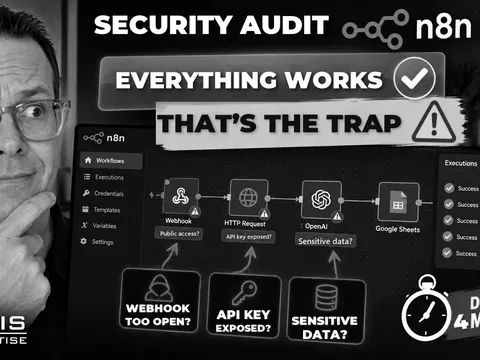
An automated audit that goes through every automation in an account and produces a report on seven points: secrets in plain text, unauthenticated triggers, missing error handler, missing timeouts, sensitive data kept in the history, orphan triggers, risky steps with no justification. A second tool automatically fixes the most frequent point.
The result
What used to take a day of reading takes a few hours, report included. And every system I deliver goes through that same list before going live.
The audit explained in four minutes. The YouTube player only loads when you click.

05Business

A business built with the tools I offer

The problem
Starting a business alone means holding ten jobs at once: the plan, the website, the posts, the videos, the tools, the prospecting. Each one takes weeks, and most self-employed people leave half of them aside.
What was built

Louis Automatise, from A to Z, in a few months, working every day with a programming assistant:

  • Planning: the business plan, the positioning, the offer, the call scripts, and the analysis of nearly 500 local businesses to choose the first thirty calls.
  • Content: the Facebook page posts, the scripts and editing of the YouTube videos, the thumbnails and images.
  • Tools: this website in French and English, published without a paid platform; the missed-calls calculator; the guide sent automatically; a text message for every email received; unsubscribes handled automatically; the documents sent to prospects before a meeting. A check runs every morning on the sixteen pages of the site and only writes to me when something is off.
The result
What would have taken a team was done by one person. A change to the site goes live in one minute, no form gets lost, and every tool I offer, I use myself first.
What I learned from itWhat slows down a solo entrepreneur is not a lack of ideas: it is the distance between the idea and the thing done. That distance is what I learned to shorten, and it is what I shorten for you.

06Guide

A guide sent, a contact recorded, with no one involved

The problem
A downloadable PDF guide is useless without follow-up, and doing it by hand doesn't hold beyond a few sign-ups.
What was built
An online form, immediate delivery of the guide by email, the contact recorded in a spreadsheet and a notification. Two languages, on a server I control. The guide form on this site is that system.
The result
A complete chain from the click to the contact record, without anyone touching it.

Get the guide

07Second brain

The second brain that does my research and feeds my Facebook page

The problem
A person working alone accumulates notes, transcripts, decisions and credentials, then spends their time looking for them instead of using them. And the background tasks — research, posts — are always put off until later.
What was built
A structured working memory: close to two hundred entries (decisions, pitfalls encountered, procedures), which an AI agent consults at the start of every work session before suggesting anything. On top of it, routines that send me a report by email, including the week's research sorted on Monday morning. And the management of my Facebook page: posts are prepared from my own texts, and written material is converted into images ready to publish on the Louis Automatise page. Non-negotiable rule: a routine produces, it doesn't act. I decide what goes out.
The result
Nothing gets lost, nothing is published without me, and the background tasks get done. It is the model I offer businesses: your memory, your procedures, your AI agent, under your own accounts.
What I learned from itAn AI agent is never better than the memory it is given. The work is writing the procedures; the AI agent itself is set up in a day.

08Competitive intelligence

Hours of monitoring summarized in a few minutes of reading

The problem
Your industry moves fast, and you feel you are falling behind what is going on in it. Keeping up with the sources that matter would take hours every week.
What was built
A family of automations that fetch the content of your sources: competitors' websites, documents published by the leading voices in your industry, YouTube videos. They summarize it (in two passes for long formats) and drop a structured summary into a document or a spreadsheet. Scheduled cadence, cap per run, deduplication.
The result
Reading goes from several hours to a few minutes per source.
What I learned from itVideo platforms block data-centre addresses. An automation of this kind cannot run just anywhere. It is the kind of detail that makes the difference between "it works on my machine" and "it works at your place".

And you

Does your case look like one of these?

Write to me. A first meeting of 30 to 60 minutes is enough to know whether your case is worth a project, and I tell you frankly when the answer is no.

Tell me about your needs

See the services offered